







Enjoying this article? Add us as a preferred source on Google.
A PlayStation 3 accessory became the main character of autumn 2026, sixteen years after it went on sale. Sony Interactive Entertainment, then still SCE, launched the CECH-ZD1J digital terrestrial recorder kit on March 18, 2010 for US$65 including tax. It is the tuner everyone knows as torne. Late in October, a method for prying that tuner away from the PS3, plugging it into a PC and running it as the tuner for a recording server spread fast, and units that had been buried in Hard Off junk bins started marching to the register one after another.
The trick is a cluster of open-source software. coax, released by Till0196, reverse-engineered control of the Fujitsu MB86H47A and DiBcom DiB8096 inside the tuner, far enough that plugging the unit into USB is all it takes to pull an ISDB-T stream out of it. From there came BonDriver_coax for using it from TVTest on Windows, torne_drv for spawning a px4_drv-compatible device on Linux, and NeToRne for driving it from Mirakurun. Related repositories kept landing in quick succession right up to October 27.
This party comes with misconceptions and caveats bundled in, though. torne is not the name of the tuner, and the four pieces of software differ wildly in character depending on one question: do you need the torne disc or not? And if you are going to talk about raw transport stream capture in Japan, there is no way around the legal risk of descrambling B-CAS.
What follows walks through what the CECH-ZD1J hardware actually contains, how the four software projects divide the work and which one fits your setup, what you need to turn it into a PC recording server, what a stability-focused fork changes when reception refuses to lock, and finally the legal risk and the used-market pricing. Honestly, I am a complete pushover for stories about hardware doing things it has no business doing.
- torne (CECH-ZD1J) is a recorder kit released March 18, 2010 at US$65
- Pick among the four programs based on whether the torne disc is required
- The unit’s own B-CAS slot works, so no separate card reader is needed
- If tuning fails, a fork with a 100ms wait interval and three retry sweeps fixes it
- Used prices reportedly climbed from around US$2 a unit to tens of dollars
Let me give away the conclusion first. coax on its own does not need the torne disc, but NeToRne assumes you have dumped it. That is the single biggest fork in the road when comparing the four projects.
*Prices in this article are converted from Japanese yen at ¥153 = US$1 (September 2026 rate).
What exactly was torne (CECH-ZD1J)? The 2010 digital terrestrial recorder kit
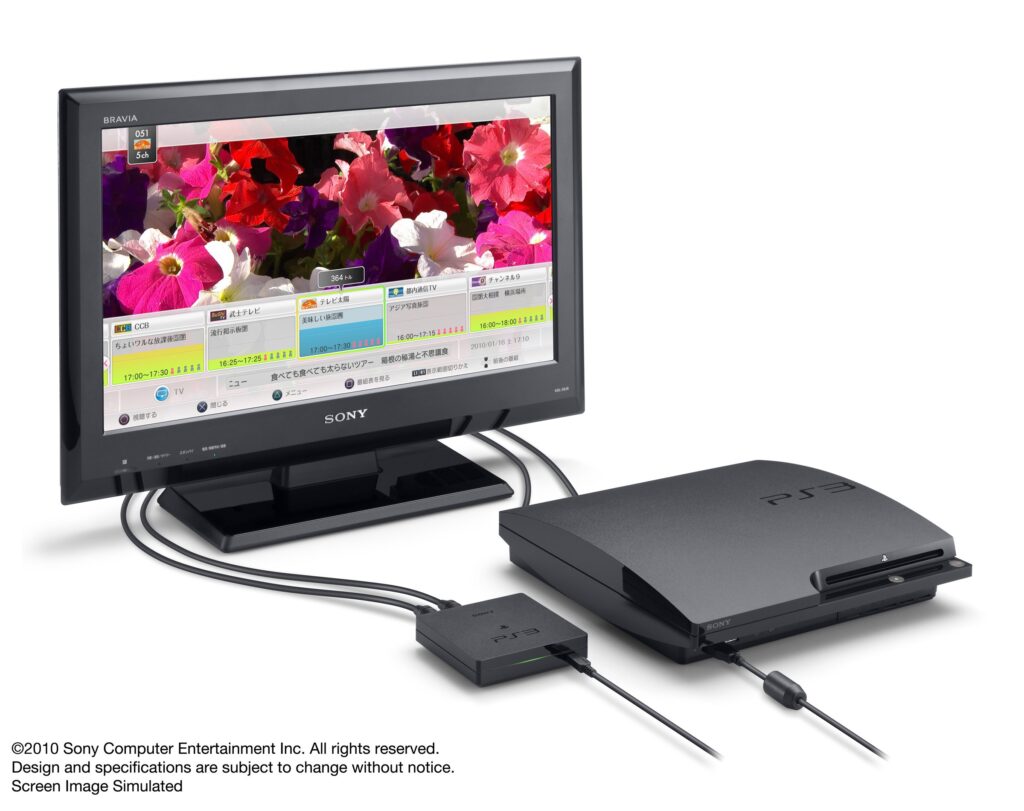
torne is the name of the PS3 feature for watching and recording television, and CECH-ZD1J is the model number of the digital terrestrial recorder kit you needed to use it.
It launched on March 18, 2010 at a suggested retail price of US$65 including tax. The kit contained a digital terrestrial tuner unit and the application, and while people routinely assume “torne” refers to the tuner unit itself, Sony has always used the word strictly as the name of the software. The name is a mash-up of “toru ne” (roughly “I’ll record it” in Japanese) and “tornado.”
The unusual part is that the PS3’s system software was modified for it. When a scheduled recording came due, the PS3 powered itself on and shut itself back down when it finished, with no startup chime. That depth of integration is exactly why the same tuner cannot be used on PS4 or PS5. The torne app itself eventually spread to PS5 (service began November 24, 2021), PS4, PS Vita, Vita TV, Android and iOS, but the CECH-ZD1J only ever plugged into a PS3.
And the chips inside are what make this whole story possible. The board definition in coax explicitly lists the Fujitsu MB86H47A alongside the DiBcom DiB8096, which packages a DiB8000 demodulator and a DiB0090 tuner into one part. The USB VID:PID is 054c:04b2, there is a single tuner, and the transmission standard is ISDB-T.
| Item | Detail |
|---|---|
| Model number | CECH-ZD1J (digital terrestrial recorder kit) |
| Release date and price | March 18, 2010 / US$65 (tax included, suggested retail price at the time) |
| Chipset | Fujitsu MB86H47A / DiBcom DiB8096 (DiB8000 plus DiB0090) |
| USB ID | 054c:04b2 |
| Tuner count and standard | One / ISDB-T (digital terrestrial only) |
| Reuse on PS4 or PS5 | Not possible (recording control is baked into the PS3 system side) |
Why is raw stream capture suddenly possible? Inside what coax reverse-engineered
Because coax, the software that drives the tuner and extracts the stream, worked out how to operate the MB86H47A and made it addressable over USB.
coax is written in Go and splits into two pieces: a client CLI called coax, with list, tune, scan, export and card subcommands, and a daemon called coaxd. Only coaxd touches hardware directly; if coaxd is not running the client starts it, and it exits on its own once nobody is using it. Binaries build for Linux, Windows and macOS with CGO disabled, and the version as of late October 2026 is 0.1.1.
Beyond direct USB control via WinUSB, IOKit and usbfs, it simultaneously carries chardev (px4_drv), pt3, pt1, Linux DVB API and Windows BDA backends, and folds all of them into a single unified tuner list. The list of supported USB devices includes the Sony CECH-ZD1 J right alongside the PLEX PX-W3U4, PX-S1UR and PX-W3U3, the MyGica T230, the KEIAN KTV-FSUSB2 and the TBS 5520SE. Seeing a PS3 accessory shelved next to PLEX tuners is symbolic to the point of being funny.
According to developer PJ Lab, torne works by having the PS3 push firmware into the tuner on every boot, and this hack takes the approach of loading a minimal firmware that does nothing but handle USB transfers. The stock firmware is encrypted and awkward to work with, the explanation adds. Sure enough, the coax setup documentation separates devices that need firmware from devices that do not, and cech-zd1j lands on the “not needed” side. That also means there is no need for fwextract to pull firmware out of a manufacturer’s distribution package.
The front LED handling is the fun detail. The LED hangs off GPIO 1 on the DiB8096, going red when driven high and green when driven low or left as an input. coaxd turns it red while in use and returns it to green on exit. In other words, somebody went out of their way to reproduce the exact behavior of the stock torne.
What separates the four programs for using torne on a PC? Start with the disc question
The short answer: the coax family does not need the torne disc, while NeToRne absolutely requires a dump of it. That is the dividing line.
NeToRne is software for using the CECH-ZD1J from TVTest on Windows or Mirakurun on Linux, and setup requires a dump of the torne disc. Specifically, you place two bin files from under BCJB95006/USRDIR plus decrypted copies of PvrRecSvr.prx and libM2tsAes.elf into C:/tvtuner on Windows or /opt/tvtuner on Linux, and the program hash-checks them at runtime. Some of those files are encrypted, so they have to be decrypted before you put them there, the documentation notes. Buying the hardware alone gets you nowhere.
torne_drv, by contrast, is an unofficial Linux driver that makes torne behave exactly like px4_drv. Video comes out at /dev/tornevideoN and reads with the same ioctl and read() calls as the px4video family. It is designed to work from recisdb, recpt1, Mirakurun, EDCB and KonomiTV as though it were a PLEX tuner, and it supports DKMS and Debian packaging so it rebuilds automatically after a kernel update. It is beta, though, and the only configuration confirmed on real hardware is a single Ubuntu 22.04 machine on kernel 5.15, x86-64.
torne_drv exists because of coax, too. Author mihalinn states outright that the method for operating the MB86H47A was reverse-engineered by coax, and explains that the coax bridge and DiB8096 handling were ported from Go to C. It is a clean illustration of an open-source chain reaction.
| Software | Role | Supported OS | torne disc |
|---|---|---|---|
| coax (by Till0196) | The core: tuner control and stream capture. CLI plus the coaxd daemon | Linux, Windows, macOS | Not needed |
| BonDriver_coax (by Till0196) | Exposes coaxd tuners to TVTest and EDCB as a BonDriver | Windows | Not needed |
| NeToRne (by YotsuhaMeru) | Use from TVTest or Mirakurun. Bundles a BonDriver and Linux capture software | Windows, Linux, NixOS | Required (dump plus decryption) |
| torne_drv (by mihalinn) | px4_drv-compatible Linux driver. Creates /dev/tornevideoN | Linux (verified on Ubuntu 22.04 hardware) | Not needed |
Which one you pick comes down to your setup. Want TVTest on Windows? coax plus BonDriver_coax. Want to fold it into Mirakurun or EDCB on Linux? torne_drv. Want a complete package with NixOS configuration examples and Mirakurun scripts included? NeToRne, with the caveat that it needs the disc. The coax README closes by stating plainly that no vendor firmware is bundled. Drawing that line explicitly deserves credit.
What do you need to build a PC recording server? The full shopping list
You need the torne unit itself, a mini-B USB cable, an antenna cable, a B-CAS card, and TVTest with BonDriver_coax.
People who have actually gotten it running report a Windows chain of torne unit to coax to BonDriverProxyEx to TVTest. Inserting BonDriverProxy means other machines on the network can use the tuner as well, they note, but the same reports list the weak points: the initial channel scan is unstable, at least one person cannot receive TOKYO MX at all, and channel switching is slow enough to grate if you are used to the PT series.
The easy-to-miss good news involves card readers. The torne unit has a B-CAS card slot, and coax can use the built-in slot of devices that have one as an ordinary card reader through a PC/SC socket (coax card). torne_drv does the same thing, handling the card through /dev/tornecardN and a pcscd driver. The card can stay seated in the torne, so there is no need to buy a separate reader.
- The torne unit itself (the CECH-ZD1J tuner unit)
- A mini-B USB cable
- An antenna cable
- A B-CAS card (it can stay seated in the unit’s slot)
- TVTest and BonDriver_coax (on Windows)
A sample layout for BonDriver_coax has been published too. You put BonDriver_coax.dll, winscard.dll, coaxd.exe, the firmware folder and Plugins\coax.tvtp (coax_plugin.dll, renamed) next to TVTest.exe, and configure everything in BonDriver_coax.ini. The procedure is to select BonDriver_coax.dll as your BonDriver, open the route and space settings from the coax plugin, run a channel scan there, then run a channel scan on the TVTest side as well.
One write-up posted to note describes implementing it with the help of the Codex AI coding agent, getting video and audio from eight stations, and confirming both manual recording and a short scheduled recording. Once reverse-engineered code goes public, follow-up work like this piles up fast.
Reception keeps dropping out? The two things a fork fixed
If tuning returns no_lock and stations never appear, the fork by aki0429, which restores the wait interval to 100ms and retries the sweep up to three times, is your candidate.
That fork was updated on October 27, and its README opens by describing itself as a reception-stability fork for the Sony torne (CECH-ZD1 J). Per the stability documentation, the symptom is that Yomiuri TV, NHK General TV Osaka, NHK General TV Kyoto and KBS Kyoto all return no_lock and cannot be tuned from TVTest. There are two fixes. The first restores the demodulator’s tuning step interval from 10ms back to 100ms, preventing the FFT and guard-interval searches from advancing on timing that is too aggressive. The second retries a failed lock attempt up to three times, clearing the channel property cache before each attempt and waiting 100ms between retries. Alongside that, I2C and USB communication errors and demodulator state machine timeouts now return as errors instead of being reported as successes.
The rigor of the verification stands out as well.
We do not count a station merely appearing in the channel list as “viewing confirmed.”
Source:aki0429/coax
The documentation goes on to explain that each frequency was test-recorded for roughly six seconds using TVTest 0.10.0 x64, with both video and audio verified through ffprobe frame analysis. The internet is stuffed with articles that declare a channel “working” the moment its name shows up in a list, so this posture is a useful model for where to place your trust.
| Test item | Detail |
|---|---|
| Test date and environment | October 27, 2026 / Windows 11 x86-64, WinUSB, one CECH-ZD1 J unit |
| Baseline for comparison | Upstream v0.1.0 (based on upstream commit 2d9f2c2) |
| Number of trials | Nine major stations received back to back through BonDriver_coax; all 12 short trials succeeded |
| Stations confirmed | Full-seg on major Osaka and Kyoto stations including 13 NHK Educational TV Osaka, 14 Yomiuri TV, 15 ABC TV and 16 MBS |
| Stations limited to 1seg | Channel 22 NHK Kobe and channel 26 Sun TV (result in this specific test environment) |
| Files changed | dib8000_tune.go, board.go, dib8096_test.go (regression test added) |
Bear in mind that this is the result from one unit in one region. Change the reception environment and no_lock behaves differently, so the same fix will not necessarily work in your house.
What should you watch out for? Legal risk and performance ceilings
Raw transport stream capture relies on a TVTest plugin to descramble B-CAS, and circumventing that kind of protection carries legal risk in Japan.
That is why the tools themselves leave the decryption piece out of what they distribute. The coax README states that no vendor firmware is bundled, and NeToRne requires users to produce the disc dump and decrypted files themselves. Both reflect the same boundary. This article does not take the position of walking you through the procedure. If you are going to try it, verify things for yourself, because I am not a lawyer either.
The performance ceiling is equally clear. Set against a dedicated tuner like the PT3, both reception stability and channel-switching speed come out worse. Each unit carries exactly one tuner, it handles digital terrestrial (ISDB-T) only, and BS and CS broadcasts are out of the question. torne_drv is beta with hardware verification on a single Ubuntu 22.04 machine, and the description for NeToRne has the author calling it an “AI Slop torne driver” himself. It is still too rough to build your main recording setup around.
The point, in short, is not “build a practical recording server on the cheap.” It is the sheer fun of watching dead hardware come back to life. Darekasan.net reads the scene as people who simply cannot resist once they learn something is hackable, and suggests they may not actually care about recording TV at all. Put that way, it is the analysis that rings truest.
How much do used units cost? From about US$2 to tens of dollars
As of October 2026, units that went for US$1 to US$4 at used shops such as Hard Off have reportedly climbed into the tens of dollars.
Shiyo posted that used stock was plentiful and a unit cost US$2, but now that the going rate has jumped by an order of magnitude, recommending it to other people feels questionable. A blogger in Nagoya wrote that the junk bin at a nearby Hard Off still had about five of them at US$1 to US$4. These are individual posts rather than official pricing, but multiple sources agree that the decimal point has moved.
And the anecdote that captures this whole frenzy comes from Mizucoffee (@mizucoffee), who bought several torne units at Hard Off and had to laugh when a staff member asked whether they were for raw stream capture. Which suggests the stores have figured it out too. People in the community have started wondering out loud what all this looks like from behind the counter.
| When and where | Reported price |
|---|---|
| Used shops before the hack spread | Reportedly around US$2 per unit |
| Junk bin at a Hard Off in Nagoya | About five left at US$1 to US$4, per one report |
| After it spread (as of October 2026) | Rate reportedly jumped an order of magnitude into the tens of dollars |
| For reference: new in 2010 | US$65 (tax included, suggested retail price for the whole kit) |
Prices move, so treat these figures as individual reports from October 2026. And if you jump in after the rate has already climbed, you are shouldering the risk of faulty or incomplete units along with it.
Enjoying this article? Add us as a preferred source on Google.
The PS3 torne as a PC recording server: everything in one place
The CECH-ZD1J is a digital terrestrial recorder kit for the PS3 that launched March 18, 2010 at US$65 including tax, and torne is the name of its application. Inside are the Fujitsu MB86H47A and the DiBcom DiB8096, the USB ID is 054c:04b2, and there is one tuner handling ISDB-T only. The project that opened the door to running it on a PC is Till0196’s coax, with BonDriver_coax for Windows, mihalinn’s torne_drv for Linux, and YotsuhaMeru’s NeToRne if you want a Mirakurun configuration included.
The axis for choosing is whether you need the torne disc. The coax family does not; NeToRne requires a dump plus decrypted files. Your shopping list is the unit, a mini-B USB cable, an antenna cable, a B-CAS card, and TVTest with BonDriver_coax, and since the card can stay in the unit’s own slot, you can skip the reader. When tuning will not lock, aki0429’s fork with its 100ms wait interval and up to three retry sweeps is worth a shot.
What you cannot forget is that descrambling B-CAS carries legal risk in Japan, and that the tools deliberately do not distribute the decryption piece. Performance does not reach PT3 levels either. Used prices have reportedly risen from the US$1 to US$4 range into the tens of dollars.
The value of this episode is not that recording hardware got cheap. It is that a 16-year-old tuner’s chipset was reverse-engineered, documented down to the GPIO number driving its LED, ported from Go to C, then fixed by a fork when reception would not lock, with video and audio checked in ffprobe before anyone dared write the word “confirmed.” That entire chain happened in public over the span of a few days. I see it as proof that DIY culture around reviving old hardware is still working exactly as it should.
If you are choosing on practicality, go PT3. And yet the urge to reach for the torne at the back of the shelf? Yeah, I get it completely.
Read Next
Snicker Kitamura











Leave a Reply