
Enjoying this article? Add us as a preferred source on Google.
Released on January 30, 2026, Mobile Suit Gundam: Hathaway’s Flash – Circe’s Witch (Kirke no Majo) is the second chapter of a planned trilogy. In its first 29 days in theaters it pulled in 2.24 billion yen and 1.34 million admissions, already surpassing the final tally of Part 1.
But box office isn’t why this movie has its hooks in people. It’s the sheer amount there is to unpack. What does the title “Circe’s Witch” actually mean? Who, or what, is Gigi Andalucia? Why does Gigi kiss Hathaway? What’s hiding under the Xi Gundam’s face mask? And what happens to a protagonist whose source novel hands him one of the bleakest endings in the entire franchise? I’ve sat through this film three times in a theater, and everything below comes out of those three viewings.
This piece digs into Part 2 from top to bottom. Heavy spoilers ahead – if you haven’t seen it, bookmark this and come back.
📌 The Basics
Title: Mobile Suit Gundam: Hathaway’s Flash – Circe’s Witch
Release date: January 30, 2026
Running time: 108 minutes
Director: Shukou Murase / Screenplay: Yasuyuki Muto
Music: Hiroyuki Sawano
Cast: Kensho Ono (Hathaway), Reina Ueda (Gigi), Junichi Suwabe (Kenneth), Soma Saito (Lane)
Production: Sunrise (Bandai Namco Filmworks), Shochiku
📖 What Happens in Part 2: “Circe’s Witch” Synopsis
Universal Century 0105, twelve years after Char’s Counterattack. A corrupt Earth Federation government is being picked apart by the anti-Federation organization Mafty Navue Erin, which keeps assassinating high-ranking officials. Behind the name is Bright Noa’s son, Hathaway Noa, now 25.
Part 1 played out in Davao. Part 2 moves the board to the Australian continent and Hong Kong. When Mafty learns that the Federation’s central cabinet conference will convene on Earth for the first time in 13 years, the group starts planning a full-scale strike on the meeting.
Meanwhile Kenneth Sleg, commander of the anti-Mafty unit code-named Circe, is approached by Handley Yoxen of the criminal police organization with a mysterious “secret arrangement” – one that pushes Kenneth well past the role of a simple pursuer.
Gigi Andalucia, who met Hathaway in Part 1, has attached herself to Kenneth and functions as the Circe unit’s “goddess of victory.” Then she deliberately lets herself be taken prisoner, which is how she ends up face to face with Hathaway again near Ayers Rock.
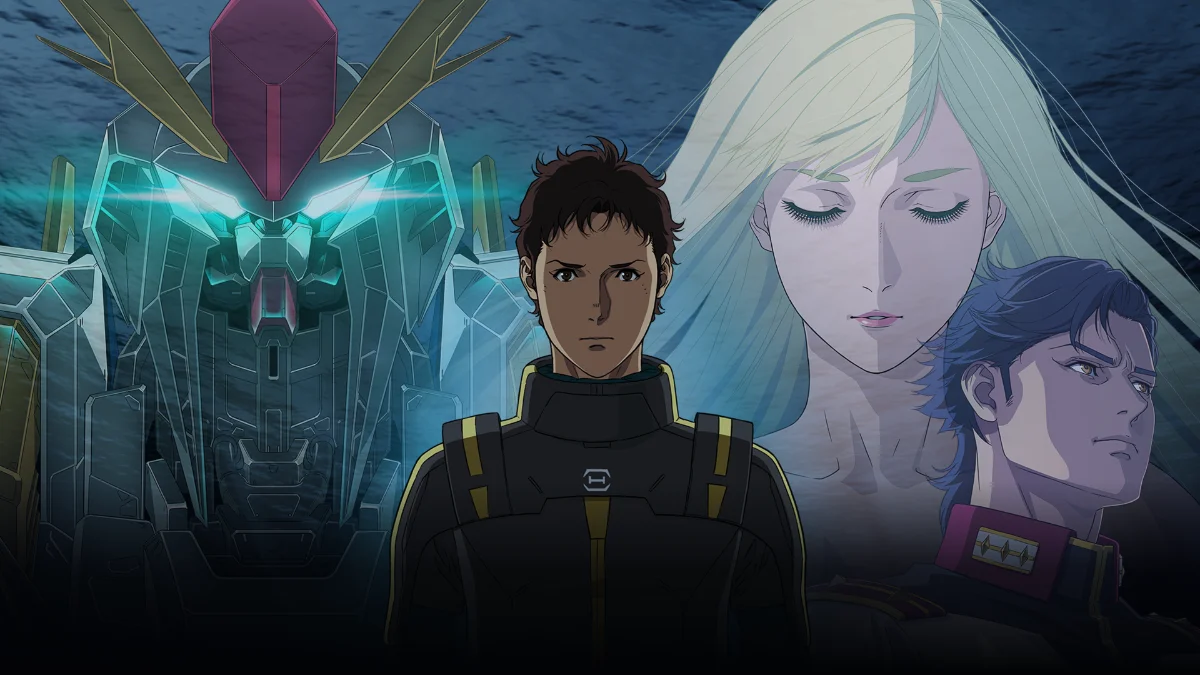
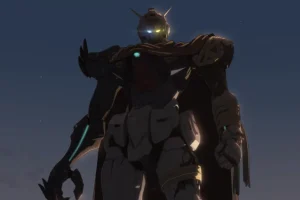
The climax pits Hathaway’s Xi Gundam against the Alyzeus, a mobile suit created for the film and piloted by Lane Aim. Mid-fight, Hathaway registers that the Alyzeus carries a mass-production type Nu Gundam in its core – and starts seeing visions of Amuro Ray and the original Nu Gundam from Char’s Counterattack. Then the Xi Gundam’s face mask cracks and falls away, revealing the true “Gundam face” underneath.
The film ends on Hathaway and Gigi kissing.
🔍 Theory 1: What “Circe’s Witch” Really Means
Circe, in Greek myth, is the daughter of the sun god Helios – a sorceress who turns men into beasts and keeps them as her own.
Kenneth names his unit Circe because of Gigi Andalucia. He clocks early that her freakish intuition works like a good-luck charm for the whole operation, and he names the unit after the kind of woman she reminds him of.
1. Gigi as the femme fatale who yanks both Hathaway and Kenneth around: she pulls in two men and keeps destabilizing the judgment of each
2. Kenneth’s Circe unit itself: the name of the task force hunting Mafty is lifted straight into the film’s title
3. The ancient Greek root of “Kirke” is “hawk”: which lines up neatly with Gigi’s sharp-eyed ability to see through people
In the myth, men who cross paths with Circe get turned into swine and other beasts. In this film, Gigi does something structurally identical to Hathaway: she strips off his “leader of Mafty” mask and turns him back into a flesh-and-blood man with feelings he can’t control. In that sense she is Circe’s witch, full stop.
🔍 Theory 2: Who Is Gigi Andalucia? A Symbol of Life Against Death
Gigi Andalucia is the single most argued-about character in this trilogy. Some fans can’t stand her – the calculating, self-serving streak reads as manipulative. Others adore her precisely for that.
The key to reading her is Hathaway’s past. Specifically, the death of Quess Paraya.
Hathaway got Quess killed in Char’s Counterattack, and at 25 he is still carrying that guilt. The strongest reading is that this is the real engine under Mafty: a self-punishing compulsion dressed up as revolution.
Quess Paraya (death): the girl Hathaway drove to her death. The embodiment of regret and guilt, and the force pulling him toward his own end.
Gigi Andalucia (life): the girl who embodies the present and the future. She shoves the fact of being alive in Hathaway’s face, and she has the power to cut him loose from a ghost.
Take that reading and the final kiss of Part 2 gets much heavier. It’s the first step Hathaway takes away from death (his guilt over Quess) and toward life (Gigi, right now, in front of him). Those few seconds carry a lot, and the next section takes them apart in detail.
The film never states outright whether Gigi is a Newtype, but she clearly picks up on what people are thinking, has flashes of near-precognitive intuition, and can smell a lie instantly. She’s being used by the Federation as their goddess of victory while quietly trying to save Hathaway – and that double game is the core of the character.
💋 Theory 3: The Kiss, or What “Dropping Your Guard” Means
Part 2’s climax: Gigi throws herself into the cockpit, and she and Hathaway kiss. It’s the image the whole film is built around, and if you know the novel, it lands as a genuine shock – because the same scene in the source material goes the other way entirely.
In Yoshiyuki Tomino’s original novel, the kiss never happens. A comparison piece by the Japanese culture outlet Real Sound lays out the difference cleanly.
Gigi is crushed – “at a moment like this, Hathaway is shielding himself with that pilot suit thing…” – and Hathaway has no idea why she’s disappointed. […] In Circe’s Witch, Hathaway has taken his helmet off, and he kisses the Gigi who has come flying into the cockpit.
Source: Real Sound
In other words, the Hathaway of the novel is a man who never lowers his guard, not even for the girl throwing herself at him. The pilot suit is physical armor that doubles as psychological armor. The film flips this 180 degrees. Helmet off – guard down – and he catches her. To me the real substance of the change isn’t the kiss. It’s the removal of the armor.
Reading 1: Gigi drives it – from “witch” to “guide”
What matters most is who initiates. The same article notes that the film’s Gigi goes to Kenneth “as the result of her own deliberate choice,” and that the late-film leap into Hathaway’s cockpit is framed the same way. The novel’s Gigi is a passive symbol – a bewitching girl shuttling between two men. The film’s Gigi chooses, then moves on her own legs. That’s the biggest change made to her.
And that agency loops the title back into the myth beautifully. Circe, unable to transform Odysseus because her magic doesn’t take, gives up on turning him into a beast, switches sides, helps him, and shows him the sea route home. She becomes a guide. Gigi’s kiss is that exact pivot: the witch who bewitches men and makes beasts of them throwing away the spell to become one man’s place to return to. “Circe’s Witch” as a title exists for this single beat.
Reading 2: Quess inverted – from atoning to the dead to answering the living
The life-versus-death contrast from Theory 2 finally becomes a concrete action here. Twelve years ago, Hathaway failed to catch a girl named Quess and she died. Now another girl comes flying at him, and this time he catches her. The kiss is a redo of twelve stalled years.
The crucial part, though, is that Gigi is not a replacement Quess. Atonement points backward, and Mafty’s self-punishing crusade is an extension of that backward-facing impulse. A kiss points at the present. Not doing something for the dead, but answering the living person in front of you. It’s the first thing in this film Hathaway does for now instead of for then.
Reading 3: An answer to the Newtype question – lips, not thoughts
The film keeps circling back to “what is a Newtype, really” (more on that in Theory 7). The Newtype ideal is understanding without words, minds meeting on a purely spiritual plane. A kiss is the opposite pole of that. No words, no thoughts, just skin on skin. As a means of understanding another person it’s the most primitive option available, and the least Newtype-like.
Choosing lips instead of a meeting of minds reads as Murase’s version of Hathaway’s Flash tipping its hand on the bigger question: can two people connect while remaining flesh-and-blood human beings? Newtype transcendence – becoming a concept, which is another way of saying dying as a human – has its own gravity, and this scene resists it with body heat. That possibility is what Gigi hands Hathaway.
Reading 4: Blessing or curse? The kiss as a device for Part 3
The biggest open question is what this kiss becomes in Part 3. If the trilogy marches toward the novel’s execution ending, that kiss turns into a memory of the one time Hathaway touched life – an amplifier that multiplies the tragedy several times over. If the ending is changed, that kiss was the fork in the road. It works either way, and that ambiguity is almost certainly why the scene was placed at the very end of Part 2.
1. Paying off the myth: the pivot from the witch who turns men into beasts to the guide who charts the way home
2. Quess inverted: from atoning to the girl he couldn’t catch, to answering the girl he did
3. An answer to the Newtype question: connecting through bodies rather than minds – a choice made by an ordinary human being
4. A device for Part 3: tragedy amplifier if the execution stands, fork in the road if it doesn’t. Ambiguous by design
Worth adding: the kiss also settles the love triangle with Kenneth. The moment Gigi chooses Hathaway of her own volition, her job as the Circe unit’s goddess of victory is effectively over. How does a Circe unit fight in Part 3 without the witch it was named after? Seen from Kenneth’s side, that kiss cranks the plot machinery just as hard.
🔍 Theory 4: The Xi Gundam’s True Face – From Fake to Real
The single biggest visual gut-punch in Part 2 is the Xi Gundam’s face mask breaking apart. The unit that fans have been calling a “Gundam knockoff” loses its mask and reveals an orthodox Gundam face underneath, complete with the classic eye slits.
Director Murase has said this was planned from the design stage of Part 1. The head was deliberately drawn slightly oversized so it could conceal the real face inside.
The Xi Gundam’s mask = the persona built around the alias “Mafty Navue Erin”
The Xi Gundam’s true face = the Hathaway Noa who was underneath it the whole time
The mask coming off = the collapse of the Mafty role and the surfacing of the actual man
Hathaway has operated as a terrorist under a borrowed name. But contact with Gigi keeps leaking the emotional, corporeal person out through the cracks, and the Xi Gundam baring its face is that persona collapse rendered as an image.
Line this up with Theory 3 and the back half of Part 2 turns out to be a double disarmament: the machine’s armor (the mask) comes off, and the pilot’s armor (the helmet) comes off. Machine and pilot show their faces at the same moment. That rhyme cannot be an accident.
How Part 3 handles this unmasked Xi Gundam should tell us how complete Hathaway’s transformation ends up being.
🔍 Theory 5: The Alyzeus Is Amuro’s Ghost
The Alyzeus (TX-ff104), a mobile suit created specifically for Part 2, has been hailed by the theory-crafting crowd as the film’s single best invention.
Officially it’s a rushed high-speed flight trainer built before the Penelope entered formal deployment. The catch is what’s in the core: a mass-production type Nu Gundam (RX-94). The Nu Gundam is Amuro Ray’s machine, the one that beat Char in Char’s Counterattack.
Fighting a machine with a mass-production Nu Gundam inside it, Hathaway starts seeing Amuro and the Nu Gundam from Char’s Counterattack. It’s the ghost of the man he can never measure up to, surfacing under maximum stress.Hathaway is Amuro’s spiritual heir who spends his life enacting Char’s ideology. “The man who rejected Amuro” and “the boy who idolized Amuro and feels guilty about it” coexist inside him, and this scene is where that pressure blows out as hallucination. That’s the strongest reading available.
The Alyzeus doesn’t appear in the novel at all. So why build it for the film? The mass-production Nu Gundam existed only as setting material in the M-MSV project and makes its animated debut here – and the purpose is obviously to make Hathaway see Amuro. It’s the best piece of psychological staging in the movie, courtesy of Murase and screenwriter Yasuyuki Muto.
🔍 Theory 6: Torn Between Amuro and Char
If you had to sum up Hathaway’s Flash as a whole in one line, it’s the story of a man being pulled apart between Amuro and Char.
Hathaway is Amuro’s son figure – Bright’s actual son, raised by a generation Amuro shaped – and yet he spends his life executing Char’s ideology: enlighten humanity, raise the flag against the Federation. The reason he can never fully believe in the righteousness of his own terrorism is that the Amuro-shaped conscience in him never entirely died.
| The Amuro side | The Char side |
|---|---|
| Human conscience and guilt | Anti-government ideology, change through purges |
| Leaning into the present with Gigi (life) | Keeping the Mafty campaign running |
| Awareness of his father, Bright | Acting to outrun his guilt over Quess |
The Amuro vision in Part 2 is a confession: I’ve stood on Char’s side by rejecting Amuro, but the real me is still dragging Amuro’s shadow around. How that split resolves is the central drama waiting in Part 3.
🔍 Theory 7: Newtype Theory and the Question of the Body
“What is a Newtype?” keeps resurfacing throughout this film. The standout moment is Kenneth holding forth on Newtypes and Gigi cutting him down with “so you’re a religious man, Colonel.”
Gigi treats Newtypes as something extremely far away from her, and she’s serenely indifferent about whether her own abilities qualify. What does that indifference mean?
Newtype ideology in Gundam has always had a whiff of liberation from the body, from desire, from worldly mess. A fully purified Newtype drifts away from human grubbiness and gets sublimated into a spirit, a concept. Which is, in a very real sense, dying as a human being.
Gigi and Hathaway, though, are written relentlessly as people with bodies. Read that as resistance against the pull of Newtype “death.” The kiss is the symbol of it – as covered in Theory 3, it’s the first time an option other than the path of the Newtype martyr appears in front of Hathaway: the option of living as a human being made of meat.
🔍 Theory 8: Handley Yoxen’s Secret Deal, the Biggest Thread Left Dangling
The most cryptic new presence in Part 2 is Handley Yoxen of the criminal police organization, voiced by Koichi Yamadera. The contents of the deal he offers Kenneth are never fully revealed, which makes it the single largest piece of setup pointing at Part 3.
1. Handley Yoxen’s secret deal: contents unknown. A mystery transaction that complicates everything Kenneth does
2. Where the Xi Gundam’s “true face” leads: the mask is off – so where does Hathaway’s transformation actually go
3. Gigi’s stated “role”: she says she’s heading to Hong Kong for the sake of her own role. What role
4. The fallout of the kiss: a Gigi who stepped down as goddess of victory, a Hathaway who dropped his guard – now what
5. The rematch with Lane Aim: Lane inflicted deep psychological damage in Part 2, and the Penelope proper is still waiting
6. Does Kenneth try to save Hathaway: in the novel he does, at the very end. How the film reinterprets that is anyone’s guess
💀 That Notoriously Bleak Novel Ending – Will the Film Change It?
You can’t talk about Hathaway’s Flash without talking about how Tomino’s novel ends.
In the book, the Mafty campaign runs its course, Hathaway is captured, and he is executed. Kenneth submits his resignation, learns his replacement is Bright Noa, and withdraws it. And then a newspaper reveals that the man who carried out Hathaway’s execution by firing squad was his own father, Bright Noa. Universal Century 105: Hathaway Noa, dead at 25. It is famous for being one of the most merciless endings in Gundam.
But producer Naohiro Ogata, discussing Part 2’s final scene – the kiss – has quoted Tomino himself saying that doing it exactly as written in the novel “wouldn’t hold up.” That’s a strong hint the film intends to change the ending.
Remember what Theory 3 established: in the novel’s version of that scene, Hathaway never lowers his guard and Gigi is left disappointed. The film has already opened a door the novel kept shut. Does it close that door again and march to the same execution ground, or does it show us what’s on the other side? Part 2’s changes and Part 3’s ending are the same problem.
Option A: Hathaway is still executed, but the detail of his father pulling the trigger gets changed
Option B: Gigi saves Hathaway and the story goes somewhere else entirely (a full pivot to a happy ending)
Option C: Hathaway lives, ending in some form of accord with the Federation or an escape
Option D: The skeleton of the ending is unchanged, but the film frames its meaning in a completely different way
The “flash” in Hathaway’s Flash refers to light that burns for an instant. The novel’s philosophical read is that Hathaway’s life is short but blazes hard while it lasts. Whether the film inherits that metaphor is the biggest question hanging over Part 3.
🎬 Looking Ahead to Part 3 and “Son of Bright”
Four and a half years separated Part 1 (June 2021) from Part 2 (January 2026). The producer has said they’ll “try to get the next one out a bit faster,” but as of April 2026 there’s no release date.
“Son of Bright” has been floating around as the working title for Part 3 for a while now. Hathaway’s fate as Bright’s son is widely expected to be the thematic core of the finale.
Father and son. Terrorist and soldier. Mafty and Hathaway. Life and death. Every binary Part 2 patiently stacked up has to be settled in Part 3. How does Shukou Murase finish adapting the most unforgiving story Yoshiyuki Tomino ever wrote for Gundam? Honestly, the waiting is part of the fun with this series.

Enjoying this article? Add us as a preferred source on Google.
✅ SPOTGEEKS VERDICT
If Part 1 of Hathaway’s Flash was the meeting, Circe’s Witch is the warning tremor before the change. The Xi Gundam’s exposed face, the kiss with Gigi, the Amuro hallucination – read them together and they form one continuous chain: a man beginning to shed the Mafty persona and choose to live as Hathaway Noa. The kiss in particular is the moment a man who kept his guard up in the novel finally drops it, and the moment the witch becomes a guide. Every theory in this article converges on those few seconds.
Tomino himself has signaled that the novel’s crushing ending won’t be transplanted as-is. Whatever light Hathaway shows us in Part 3, the word “flash” is going to mean something different on screen than it did on the page.
Read Next

Snicker Kitamura


Leave a Reply