





Enjoying this article? Add us as a preferred source on Google.
On April 28, 1988, Konami released a shooter for the MSX starring an octopus who talks in a thick Kansai dialect. It was a full-on parody of the company’s own Gradius, and it was called Parodius: Tako Saves Earth. Two years later, on April 25, 1990, Parodius Da! hit arcades, took 2nd place for Game of the Year and 1st for Best Shooting Game at the 4th Gamest Awards, and the series became a household name overnight.
There are seven standalone releases carrying the Parodius name, from the MSX original all the way to Parodius Portable on the PSP: three arcade games, one home-console original, two compilations, and the MSX game where it all started. The last standalone release was Portable on January 25, 2007. Since then, all we’ve gotten are mobile phone apps, Virtual Console releases, and a Project EGG release. Which means the whole series now fits neatly on a single table.
In this article, I scored all seven games out of 100 on four axes (Accessibility, Graphics, Brutality, and Replay Value) and ranked them by total score. No. 1 is 1994’s Gokujō Parodius, and No. 2 is 1990’s Parodius Da!. And as of November 16, 2026, only one of the seven can be played on current platforms. I also laid out which ones you can still buy and which ones you can’t.
A higher “Brutality” score means the game bites back harder. A lower score doesn’t mean it’s worse. If you love shooting bells into different colors, ballooning into a giant, and dying while laughing, pick from the games that score high here. Putting the original at No. 7 stings a little, but the scores are the scores.
- What is the Parodius series? Konami’s side-scrolling shooter that parodies its own Gradius
- All 7 Parodius games: score comparison
- No. 1 is Gokujō Parodius, crowned by co-op and the “Angry” state
- When is the next Parodius game or port? Where can you play now?
- Can you play the 7 games on current platforms? A complete platform-by-platform guide
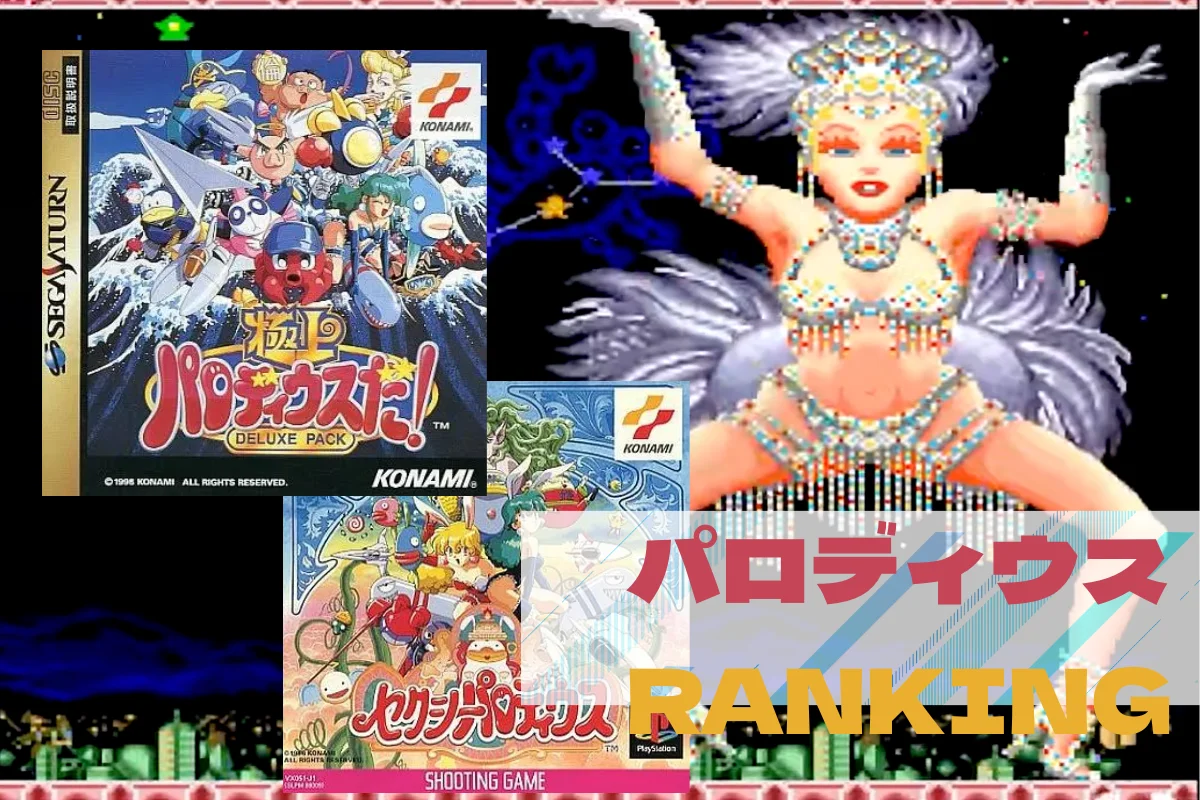
The ranking is limited to standalone releases with Parodius in the title. I counted Gokujō Parodius Da! Deluxe Pack, which bundles Da! and Gokujō, and Parodius Portable, which packs in five games, as standalone releases. Mobile phone apps and the Wii/Wii U Virtual Console releases are no longer available, so they’re left out.
*Prices in this article are converted from Japanese yen at ¥159 = US$1 (November 2026 rate).
What Is the Parodius Series? Konami’s Side-Scrolling Shooter That Parodies Its Own Gradius
The Parodius series is a line of side-scrolling shooters Konami launched with the 1988 MSX game. The name comes from the fact that it’s an in-house parody of the Gradius series, and by tradition the playable roster always includes Vic Viper, the hero ship of Gradius. The music is arrangements of public-domain classical pieces and Konami’s own game tunes, and on top of the gauge-style power-up system, it has TwinBee-flavored elements like roulette capsules and bell power-ups.
The main series consists of the 1988 MSX game, three arcade games from 1990, 1994, and 1996, and Jikkyō Oshaberi Parodius, a Super Famicom original from 1995. They were followed by two compilations: the Deluxe Pack in 1994 and Portable in 2007. The arcade games placed high at the Gamest Awards every time, with Da! taking 2nd for Game of the Year and Gokujō taking 6th.
- You get to fly Konami mascots like Vic Viper, Tako, TwinBee, and Pentarou side by side
- Da! took 2nd and Gokujō 6th for Game of the Year at the Gamest Awards. It wears a comedy face, but the acclaim is real
- Color-shifting bells, turning giant, and classical music arrangements give it a personality you won’t forget after one go
- Since Parodius Portable on January 25, 2007, there’s been no new game and no port to current platforms, and as of November 16, 2026, nothing has been officially announced
- The only version playable on current platforms is the MSX game on Project EGG for Windows
All 7 Parodius Games: Score Comparison
I scored each game out of 100 on four criteria. A higher “Brutality” score means the game bites back harder. A lower score doesn’t make it worse. Don’t just look at the total; pick based on the axis that matters most to you.
| Title | Accessibility | Graphics | Brutality | Replay Value | Total Score |
|---|---|---|---|---|---|
| No. 1 Gokujō Parodius! ~Kako no Eikō o Motomete~ | 86 | 92 | 72 | 90 | 340 |
| No. 2 Parodius Da! -From Myth to Laughter- | 84 | 85 | 78 | 85 | 332 |
| No. 3 Sexy Parodius | 68 | 90 | 88 | 84 | 330 |
| No. 4 Parodius Portable | 90 | 84 | 60 | 95 | 329 |
| No. 5 Jikkyō Oshaberi Parodius | 82 | 80 | 70 | 80 | 312 |
| No. 6 Gokujō Parodius Da! Deluxe Pack | 78 | 86 | 74 | 72 | 310 |
| No. 7 Parodius: Tako Saves Earth | 60 | 60 | 85 | 70 | 275 |
The top Graphics score goes to Gokujō Parodius, the top Brutality score to Sexy Parodius with its quota system, and the top Replay Value score to Parodius Portable with its five games. No. 1 and No. 2 are 8 points apart, and I put Gokujō on top because two-player co-op and the “Angry” state add a range of play Da! doesn’t have. No. 3 and No. 4 are separated by a single point. Sexy is for players who want to grind, Portable is the one to start with, and they couldn’t be more different in character.
[No. 1] Gokujō Parodius! ~Kako no Eikō o Motomete~: The 1994 Game That Took the Crown With Co-op, the Angry State, and Yoshitoo Asari’s Art
| Accessibility | Graphics | Brutality | Replay Value | Total Score |
|---|---|---|---|---|
| 86 | 92 | 72 | 90 | 340 |
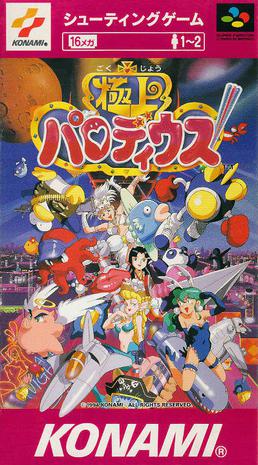
Gokujō Parodius! ~Kako no Eikō o Motomete~ (released in Europe as Fantastic Journey) hit arcades on April 26, 1994. It was developed by Konami Development Division 2, runs on Konami System GX hardware, and supports 1 to 2 players simultaneously. The Super Famicom version came out on November 25 of the same year. Manga artist Yoshitoo Asari handled the illustrations, and the music pool expanded beyond classical pieces to children’s songs from around the world and traditional Japanese nursery rhymes.
The playful spirit runs through everything. There’s Karā Itao, the color-board boss who won’t go down until you pump 256 shots into him; a board marked “1M” in the special stage that won’t break until you hit it 65,536 times; and the kindness of arrows pointing out each boss’s weak spot. In two-player co-op, if one player keeps shooting the other, the player getting hit goes into the “Angry” state and sprays high-speed shots in every direction for a set time. Koitsu, the scribbled stick figure riding a paper airplane, won 1st for Best Character at the 8th Gamest Awards for that design alone. At the same awards, the arcade version placed 6th for Game of the Year, 6th for Best Direction, and 6th for Best VGM.
- Two-player co-op and the Angry state give it the widest range of play in the series
- The 256-shot color-board boss, weak-point arrows, and nursery rhyme arrangements: everything is packed with fun
- A track record of 6th for Game of the Year at the Gamest Awards, plus 1st for Best Character for Koitsu
- As of November 16, 2026, there’s no port to current platforms. To play it, you’ll need a used copy of the Super Famicom version, the Deluxe Pack, or Portable
- The “1M” board in the special stage really does take 65,536 shots. You’ll be laughing while your trigger finger dies
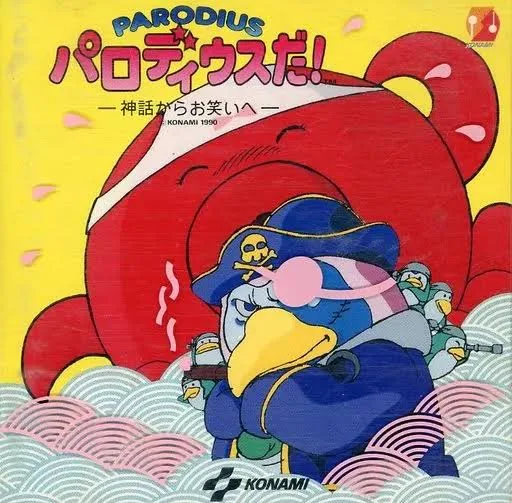
[No. 2] Parodius Da! -From Myth to Laughter-: The 1990 Game That Took 2nd for Game of the Year and 1st for Best Shooting Game at the Gamest Awards
| Accessibility | Graphics | Brutality | Replay Value | Total Score |
|---|---|---|---|---|
| 84 | 85 | 78 | 85 | 332 |
Parodius Da! -From Myth to Laughter- hit arcades on April 25, 1990, developed and published by Konami. The subtitle is a riff on Gradius III: From Legend to Myth. The core system follows Gradius, but like its predecessor it has roulette capsules and bell power-ups, and each character uses different weapons. Bells change color when you shoot them, and depending on the color you grab, you get a score boost, a super bomb, a megaphone, a giant-size transformation, and more.
The playable ships are Vic Viper (whose backstory makes him a taiyaki shop owner), Tako, back as Mr. Parodius from the previous game, a TwinBee designed to look like WinBee, and Pentarou, the child of Penguin Adventure’s penguin and Penko. Its cute characters and wild stage design pushed the series’ popularity way up, and it won 2nd for Game of the Year, 1st for Best Shooting Game, and 1st for Best Direction at the 4th Gamest Awards. It was ported to the Famicom on November 30, 1990, the Game Boy on April 5, 1991, the X68000 on April 19, 1991, the PC Engine on February 21, 1992, and the Super Famicom on July 3, 1992, landing on nearly every major platform of the early ’90s.
- 2nd for Game of the Year and 1st for Best Shooting Game at the Gamest Awards: the highest acclaim in the series
- Ported to five platforms from the Famicom to the X68000, so if you’ve got the old hardware, you can play it on one of them
- The game where the series’ grammar of color-shifting bells and going giant came together
- Two players alternate turns; there’s no simultaneous play
- No port to current platforms. You’ll need a used physical copy or Portable on PSP
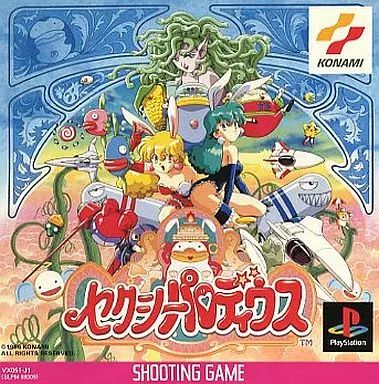
[No. 3] Sexy Parodius: The Third Arcade Game, Branching on Missions and the Toughest in the Series
| Accessibility | Graphics | Brutality | Replay Value | Total Score |
|---|---|---|---|---|
| 68 | 90 | 88 | 84 | 330 |
Sexy Parodius hit arcades in March 1996, the third arcade entry and the first in two years since Gokujō Parodius. Konami developed and published it, and the PlayStation and Sega Saturn versions came out on November 1, 1996. It introduced stage branching: a mission is explained at the start of each stage, and whether you clear it decides which stage comes next. In Stages 2 and 3, meeting the quota sends you to route A, and missing it sends you to route B. It was the first game in the series to show a boss health bar, and like its predecessor, it supports two-player co-op.
With the quota system and a high-speed scrolling stage as early as Stage 2, the overall difficulty is high, and it’s said to have never reached the popularity of its predecessor. The palace stage has a time limit, and if time runs out, the game ends on the spot with the bad ending. Clear every quota and you can take on a special stage after the ending, set to a medley of Konami shooter music, where clearing it awards 1 million points per remaining life. It’s built for players who grind, and its Brutality score of 88 is the highest in the series.
- The only game in the series where clearing missions changes your route
- Boss health bars, time limits, and million-point bonuses give score chasers plenty to work with
- PS and Saturn versions make it easy to recreate the arcade experience at home
- Keep drifting into the failed-quota B routes and you won’t reach the good ending
- The difficulty is high, so it’s not a good first Parodius
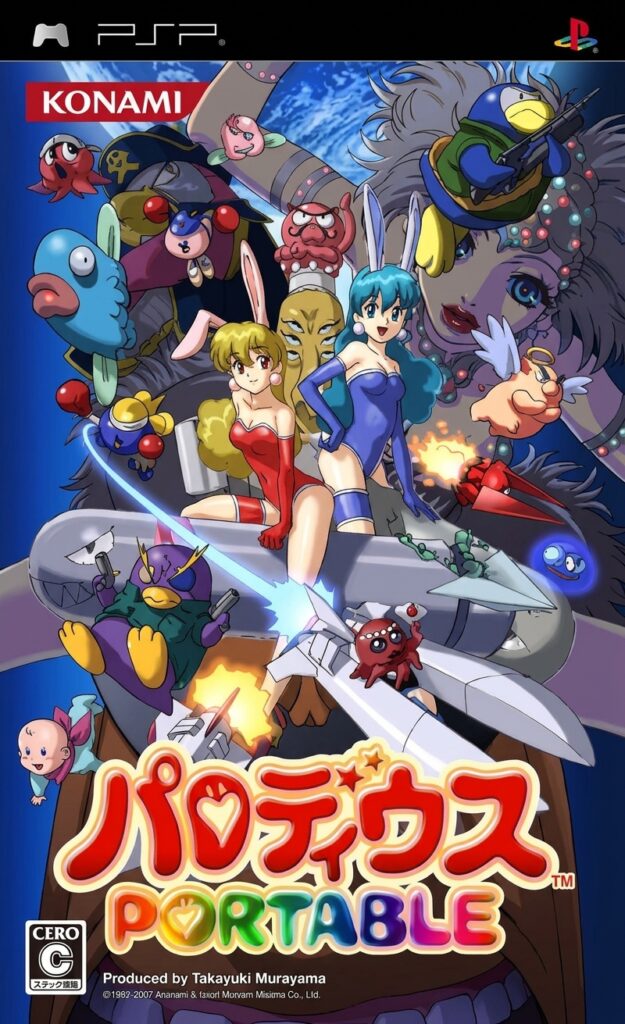
[No. 4] Parodius Portable: Five Games in One, and the Easiest Way In
| Accessibility | Graphics | Brutality | Replay Value | Total Score |
|---|---|---|---|---|
| 90 | 84 | 60 | 95 | 329 |
Parodius Portable is a PlayStation Portable game released by Konami Digital Entertainment on January 25, 2007, an omnibus collecting five games in the series. It includes the arcade versions of Parodius Da!, Gokujō Parodius, and Sexy Parodius, the PlayStation version of Jikkyō Oshaberi Parodius ~forever with me~, and a powered-up arranged port of the original Parodius: Tako Saves Earth, which was billed as a secret title when the collection was first announced. It’s single-player only.
Since one disc gets you nearly the entire main series, I gave it top marks for Accessibility and Replay Value. Brutality sits at 60 because, as a single-player handheld release where you can pick your difficulty, it’s a different beast from the tension of the arcade. It’s now been 19 years since this became “the last Parodius.”
- Five games on one disc: three arcade games, the PS version of Jikkyō, and an arranged version of the original
- Its Replay Value score of 95 is the series high. Hunting this one down first is the shortcut
- It’s PSP-only, and the PSP store is closed. Your only option is a used UMD
- It’s single-player, so you can’t recreate the two-player co-op of Gokujō or Sexy

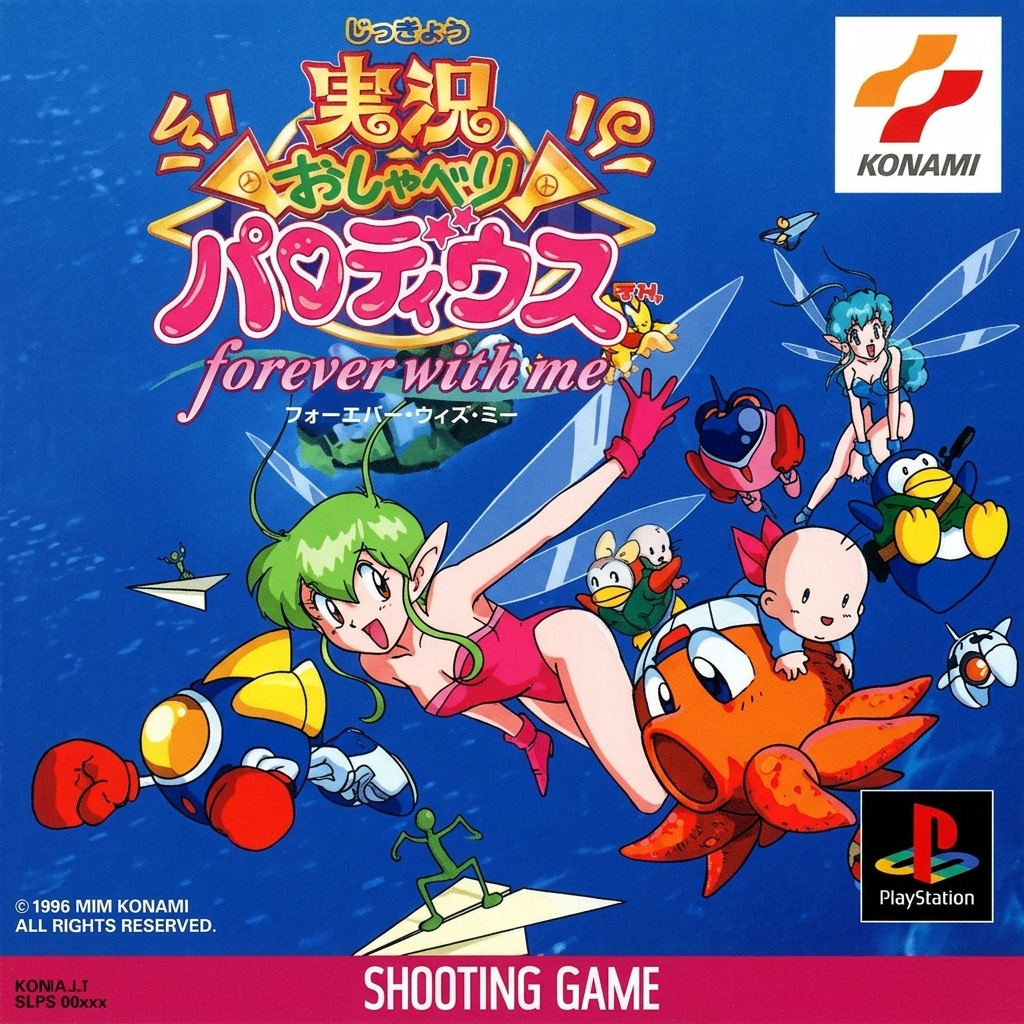
[No. 5] Jikkyō Oshaberi Parodius: The Oddball Home-Console Original Where an Announcer Talks on the Super Famicom
| Accessibility | Graphics | Brutality | Replay Value | Total Score |
|---|---|---|---|---|
| 82 | 80 | 70 | 80 | 312 |
Jikkyō Oshaberi Parodius is a Super Famicom game released by Konami on December 15, 1995, developed by KCE Osaka Development Division 11, and it’s single-player. As the name suggests (“Live Chatty Parodius”), its biggest hook is an announcer who talks while you play, and it was also the first game in the series to include a boss rush stage. Illustrations are by Yoshitoo Asari.
The Sega Saturn version on December 13, 1996 and the PlayStation version on December 20 of the same year were retitled Jikkyō Oshaberi Parodius ~forever with me~. They’re essentially arranged versions, with the stage layout and most of the content changed, and they support two-player co-op. The version included in Portable on PSP is this PlayStation release. The SFC version and the 32-bit console versions have different content, so your impression will depend on which one you played.
- The sheer surprise that a Super Famicom game talks this much is its whole personality
- forever with me supports two-player co-op and plays as a different game from the SFC version, so you can enjoy it twice
- The SFC version is single-player; for two players, go with the Saturn or PS version
- No port to current platforms. You’ll need a used physical copy or Portable
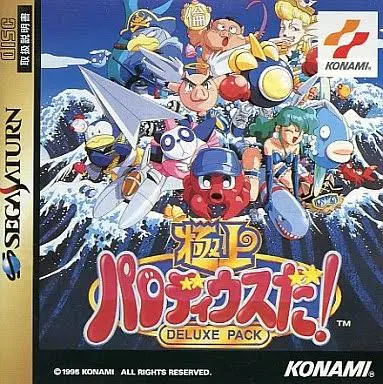
[No. 6] Gokujō Parodius Da! Deluxe Pack: A Two-Game Set That Brought Da! and Gokujō Home Arcade-Perfect
| Accessibility | Graphics | Brutality | Replay Value | Total Score |
|---|---|---|---|---|
| 78 | 86 | 74 | 72 | 310 |
Gokujō Parodius Da! Deluxe Pack is a compilation of two arcade games, Parodius Da! -From Myth to Laughter- and Gokujō Parodius! ~Kako no Eikō o Motomete~, published by Konami. The PlayStation version came out in December 1994 and the Sega Saturn version on May 19, 1995, with a list price of $36 (before tax). Being able to play the 1994 arcade version of Gokujō at home within the same year is a turnaround that’s still rare today.
I ranked it below Portable. With only two games and no Jikkyō or Sexy, it falls behind on Replay Value. That said, playing two arcade games on a 32-bit console has a feel that’s worth something different from the PSP’s little screen. As a Saturn guy, part of me wants to push this one.
- Includes Da! and Gokujō, both just as they were in the arcade
- Released on both PS and Saturn, so there are relatively plenty of used copies around
- Only two games. That’s thin next to the five in Portable
- No port to current platforms
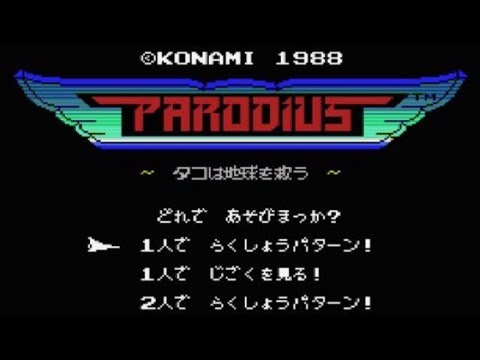
[No. 7] Parodius: Tako Saves Earth: The MSX Original Starring a Kansai-Dialect Octopus
| Accessibility | Graphics | Brutality | Replay Value | Total Score |
|---|---|---|---|---|
| 60 | 60 | 85 | 70 | 275 |
Parodius: Tako Saves Earth is an MSX game released by Konami on April 28, 1988, and the first game in the series. The hero is an octopus who calls himself a “programmer of dreams and hope,” speaks in Kansai dialect, and wears a headband that reads “Entertainer.” He’s joined by Konami characters like the penguin from Penguin Adventure, Goemon from Ganbare Goemon, and Popolon from Knightmare. It supports 1 to 2 players, alternating turns.
By series convention, the final boss is a pushover, but this original is the one exception. That’s where its Brutality score of 85 comes from, while its graphics are limited by what the MSX could do, so that score stays low. Even so, this is the only Parodius you can play on current platforms: it’s been available on Project EGG for Windows since April 11, 2014. It was also released on the Wii and Wii U Virtual Console, but those have ended.
- You can experience the series’ origin, Kansai-dialect octopus and all, exactly as it was
- As of November 16, 2026, it’s the only Parodius you can play, via Project EGG (Windows)
- The series’ sole exception where even the final boss doesn’t go easy on you
- Project EGG requires membership plus the EGG service ($3 per month)
When Is the Next Parodius Game or Port? Where Can You Play Now?
As of November 16, 2026, there’s been no official announcement of a new Parodius game or a port to current platforms. The last standalone release was Parodius Portable on January 25, 2007, and since then there have only been Virtual Console releases on Wii and Wii U and the Project EGG release on April 11, 2014.
How Much Does It Cost to Buy In Now?
The only one you can buy new is the MSX version on Project EGG. Everything else means used physical copies, so prices vary by store and condition. For reference, the Deluxe Pack had a list price of $36 (before tax), and Portable, with its five games, has plenty of used copies in circulation.
| Game | Where to Get It | Notes |
|---|---|---|
| Parodius (MSX version) | Windows (Project EGG) | $3 + EGG service at $3 per month. Released April 11, 2014 |
| Parodius Portable | PSP (used UMD) | 5 games included. PSP store closed |
| Gokujō Parodius Da! Deluxe Pack | PS / SS (used) | List price $36 (before tax). Da! + Gokujō |
| Sexy Parodius | PS / SS (used) | Released November 1, 1996 |
| Jikkyō Oshaberi Parodius ~forever with me~ | PS / SS (used) | Released December 1996. Different content from the SFC version |
Which Game in the Series Should You Start With?
If you can hunt down a used copy, Portable is the only answer. Five games, and you can choose your difficulty. Original-hardware fans should start with the Super Famicom version of Gokujō or any version of Da!. If you want to stick to current platforms only, all you can do is try the MSX version on EGG and wait for a port to be announced.
Can You Play the 7 Parodius Games on Current Platforms? A Complete Platform-by-Platform Guide
✅ The Verdict
Of the seven games covered here, only one is playable on current platforms as of November 16, 2026. That’s the MSX version of Parodius: Tako Saves Earth on Project EGG for Windows. There isn’t a single Parodius game you can buy on Nintendo Switch, PS5, PS4, or Steam. The remaining six can only be played via used physical copies.
1. Titles Available via Subscription or for Free
As of November 16, 2026, we couldn’t find any Parodius games available through subscriptions like Nintendo Switch Online or PlayStation Plus. There are no free-to-play entries either.
2. Titles Available as Standalone Purchases
| Title | Platform | Price / Notes |
|---|---|---|
| Parodius: Tako Saves Earth (MSX version) | Windows (Project EGG) | $3. Requires the separate EGG service at $3 per month |
3. Titles Available as Remasters or Remakes
As of November 16, 2026, no remasters or remakes exist. The most recent port is Portable on PSP (2007), and no HD version or re-release for current platforms has been officially announced.
4. Titles Hard to Get on Current Platforms
| Title | Platform | Price / Notes |
|---|---|---|
| Parodius Da! -From Myth to Laughter- | AC / FC / GB / X68000 / PCE / SFC | Used physical copies. Alternatives: Deluxe Pack (PS / SS) or Portable (PSP) |
| Gokujō Parodius! ~Kako no Eikō o Motomete~ | AC / SFC | Used physical copies. Alternatives: Deluxe Pack or Portable |
| Sexy Parodius | AC / PS / SS | Used PS and SS versions. Alternative: Portable |
| Jikkyō Oshaberi Parodius | SFC / SS / PS | Used physical copies. The PS version is included in Portable |
| Gokujō Parodius Da! Deluxe Pack | PS / SS | Used only |
| Parodius Portable | PSP | Used UMD only. With 5 games included, it’s the strongest stand-in for the whole series |
Start by picking up a used copy of Portable. If that’s not enough, add the Saturn or PS version to get the two-player co-op of Gokujō and Sexy. Whether a re-release for current platforms ever comes is up to Konami, and all we can do is wait for an announcement.

Enjoying this article? Add us as a preferred source on Google.
Wrap-Up: Gokujō Parodius Tops the Four-Axis Scores, and Only 1 of 7 Is Playable on Current Platforms
After scoring all seven standalone Parodius releases on four axes, No. 1 is Gokujō Parodius! ~Kako no Eikō o Motomete~ (340 points), which hit arcades on April 26, 1994; No. 2 is Parodius Da! -From Myth to Laughter- (332 points), which hit arcades on April 25, 1990; and No. 3 is Sexy Parodius (330 points), which hit arcades in March 1996. The only one playable on current platforms is the MSX version on Project EGG, and as of November 16, 2026, there’s no official announcement of a new game or port.
The bottom line on buying: track down a used copy of Parodius Portable. It has five games, and that one disc covers the main series. If you want two-player co-op, add the Deluxe Pack or the PS or Saturn version of Sexy.
It’s rare for a series that boasts a 2nd-place Gamest Game of the Year to have not a single game you can buy on current platforms. Every time Gradius gets a re-release, people say “Parodius next?”, and that’s been going on for years now. Gokujō takes the top score, but the one most worth owning right now is Portable. If you spot it on a used-game shelf, don’t hesitate.
It’s been 38 years since a Kansai-dialect octopus saved the Earth. I think it’s someone else’s turn to save Parodius.











Leave a Reply